THE IDEA TO KEEP
を often marks what an action affects. に can mark a destination or recipient. Learn movement expressions with their verbs, not as isolated nouns.
01What do you eat, read, or buy?
With many everyday action verbs, を marks the direct object: the thing you eat, read, buy, or watch. It is normally pronounced o in modern Japanese. In 本を読みます, the book is not a destination or a place where reading happens; it is what you read. The verb tells you the kind of relationship to look for.
本を読みます。
Hon o yomimasu.
I read a book.
02Who receives it? Where do you go?
に is useful when you identify the recipient of something or the endpoint of movement. In 友達に本をあげます, the friend receives the book and the book is what you give. Both markers belong in the same sentence because they label different roles. You do not choose one particle for the entire action.
友達に本をあげます。
Tomodachi ni hon o agemasu.
I give a book to a friend.
駅に行きます。
Eki ni ikimasu.
I go to the station.
03Getting on and off: learn the whole expression
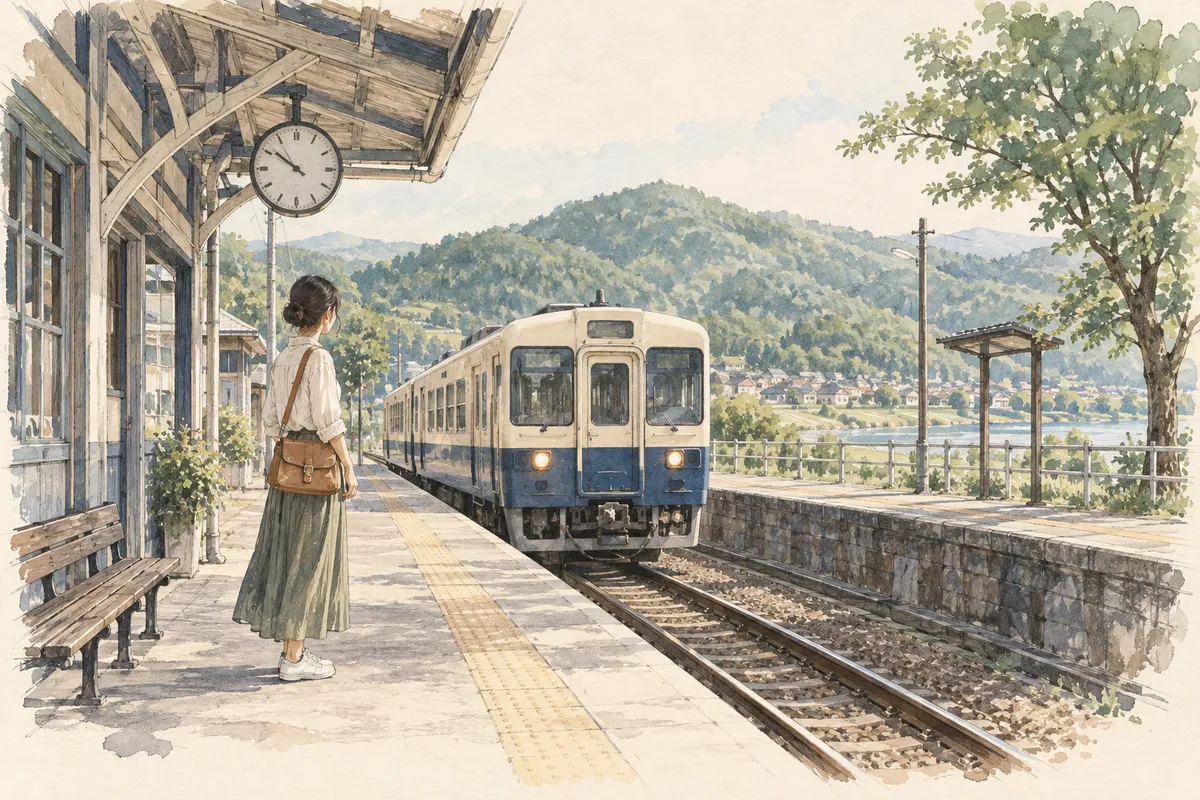
電車に乗ります means you get on the train. 電車を降ります means you get off it. In the second expression, を marks what you leave, not an object in the same sense as a book you read. Japanese を also has route and departure uses, so the beginner label “object marker” does not explain every sentence.
電車に乗ります。次の駅で電車を降ります。
Densha ni norimasu. Tsugi no eki de densha o orimasu.
I board the train. I get off at the next station.
04Watch for routes, too
公園を歩きます describes walking through or around a park. The park is the route or area traversed. 公園で歩きます instead presents the park as the setting for walking. These are both possible with different framing. Before marking an answer wrong, check whether the intended meaning is an object, a destination, a departure point, or a route.
YOUR TURN
Make the connection.
Read the situation before choosing. The reason matters as much as the answer.
Further reading & a note on these guides
ParticleQuest creates these examples and explanations with AI-assisted drafting. Japanese usage depends on context, and these introductory patterns do not cover every construction. Continue with the Japan Foundation’s learning materials below.
A little repetition. A stronger connection.
Build on this guide with focused particle-pair practice and mistake review in the app.
Explore ParticleQuest