
THE IDEA TO KEEP
Separate how you travel, where you go, and where you get on or off. Each relationship has its own pattern.
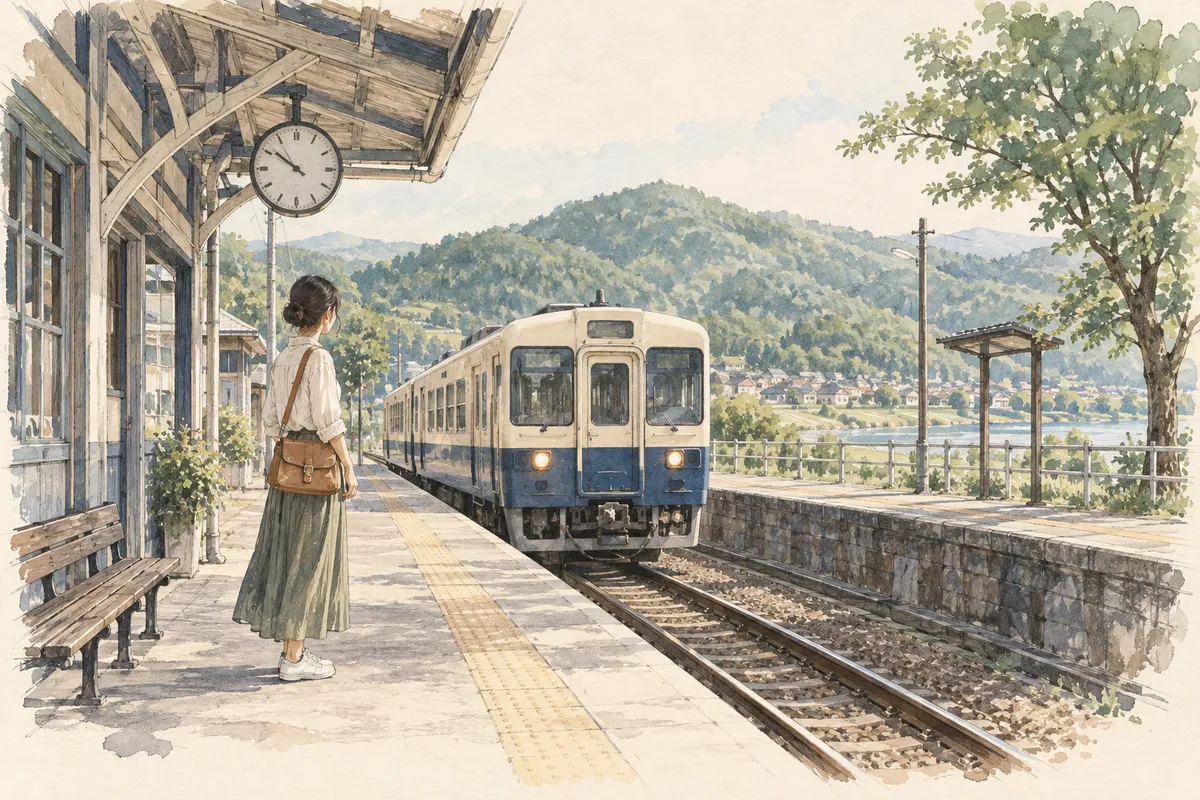
01Say how you get there
電車で京都に行きます names both the means and the destination. で attaches to the train because it is how you travel. に attaches to Kyoto because it is where you go. You can also use 京都へ行きます to describe heading toward Kyoto; a beginner exercise should not mark that form wrong when the context permits both.
電車で京都に行きます。
Densha de Kyōto ni ikimasu.
I go to Kyoto by train.
02Boarding and leaving the train
Use 電車に乗ります for boarding and 電車を降ります for getting off. To add the station where you get off, use 京都駅で電車を降ります. In that sentence で marks where the action occurs, while を connects the vehicle with the leaving verb. Keep the complete pattern in your notebook; it is more useful than memorizing “train = で.”
京都駅で電車を降ります。
Kyōto-eki de densha o orimasu.
I get off the train at Kyoto Station.
03Ask about a route and its duration
から marks the place you start from; まで marks how far the route extends. 駅からホテルまで combines them into a route you can ask about. In どのくらいかかりますか, the question asks for a duration. A reply such as 十分ぐらいです means “about ten minutes.” That duration is different from a departure time such as 十時に.
駅からホテルまでどのくらいかかりますか。
Eki kara hoteru made dono kurai kakarimasu ka.
How long does it take from the station to the hotel?
04Walking is a useful pattern of its own
“On foot” is commonly expressed with 歩いて, as in 駅まで歩いて行きます. Do not mechanically put で after every way of moving: 歩いて is already a verb form that links walking to going. Write a short itinerary using one train journey, one place you get off, and one walking segment. This tests the relationships in a realistic order.
YOUR TURN
Make the connection.
Read the situation before choosing. The reason matters as much as the answer.
Further reading & a note on these guides
ParticleQuest creates these examples and explanations with AI-assisted drafting. Japanese usage depends on context, and these introductory patterns do not cover every construction. Continue with the Japan Foundation’s learning materials below.
A little repetition. A stronger connection.
Build on this guide with focused particle-pair practice and mistake review in the app.
Explore ParticleQuest