THE IDEA TO KEEP
With many movement verbs, に highlights the destination and へ the direction. Both can describe the same journey; their other uses are not interchangeable.
01Two natural ways to describe a journey
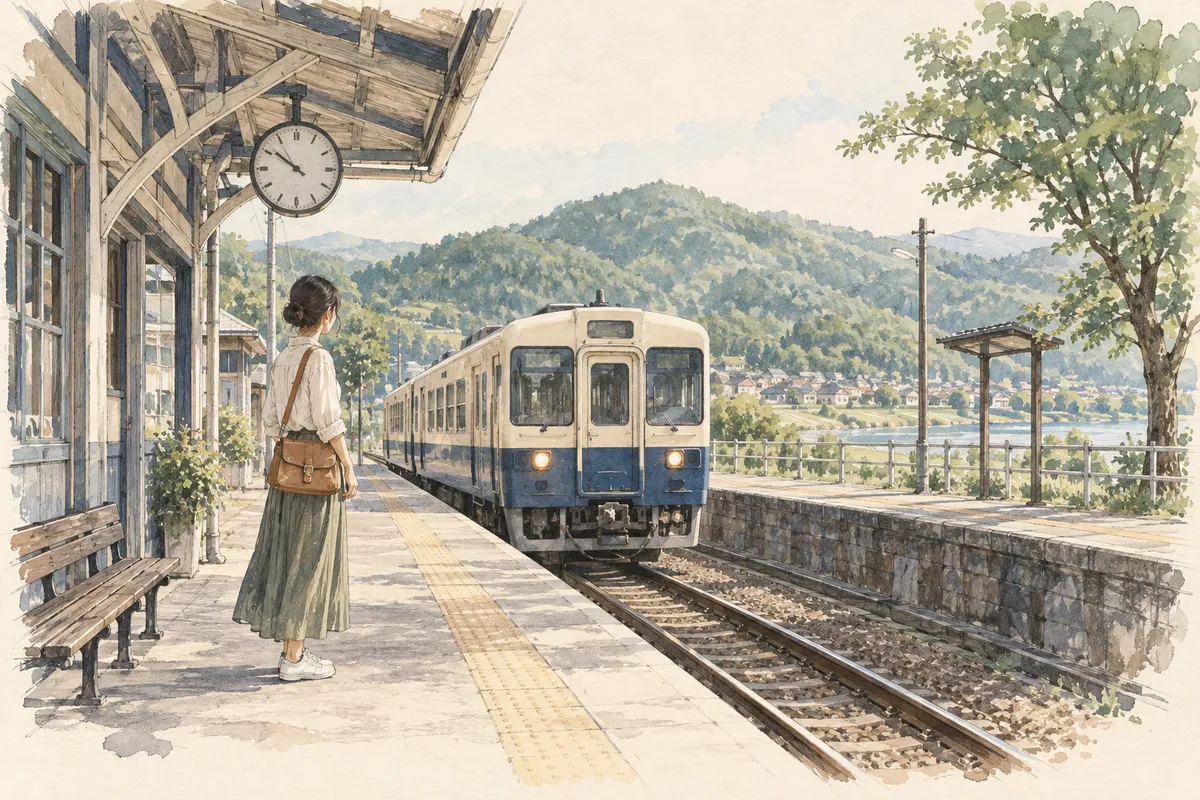
東京に行きます and 東京へ行きます can both mean “I am going to Tokyo.” に presents Tokyo as the destination; へ presents movement toward Tokyo. In ordinary conversation, the distinction may be subtle. Do not invent a rule that へ means you will never arrive, or that に guarantees the journey has already finished.
東京に行きます。
Tōkyō ni ikimasu.
I am going to Tokyo.
東京へ行きます。
Tōkyō e ikimasu.
I am heading to Tokyo.
02Keep the movement verb in view
You will often see both particles with 行く, 来る, and 帰る. The verb establishes the movement; the particle frames the place. A train announcement, a travel plan, and a postcard may choose different wording without describing a different destination. Read the complete sentence and avoid treating a translation as proof that only one option is grammatical.
03Where the swap stops working
に has many functions unrelated to direction. In 七時に起きます, it marks a time. In 部屋にいます, it marks existence in a room. Replacing these with へ does not preserve the intended meaning. Likewise, 電車に乗ります is a construction to learn as a unit; the broad “direction” explanation is not a license to swap particles after every place or vehicle.
七時に起きます。
Shichi-ji ni okimasu.
I get up at seven.
04Try a destination diary
Write three places you plan to go this week using に行きます. Rewrite them with へ行きます and notice the shift in framing. Then write a sentence about where you are now using にいます. Keeping the movement and existence examples next to each other helps you remember both the overlap and the boundary.
YOUR TURN
Make the connection.
Read the situation before choosing. The reason matters as much as the answer.
Further reading & a note on these guides
ParticleQuest creates these examples and explanations with AI-assisted drafting. Japanese usage depends on context, and these introductory patterns do not cover every construction. Continue with the Japan Foundation’s learning materials below.
A little repetition. A stronger connection.
Build on this guide with focused particle-pair practice and mistake review in the app.
Explore ParticleQuest